
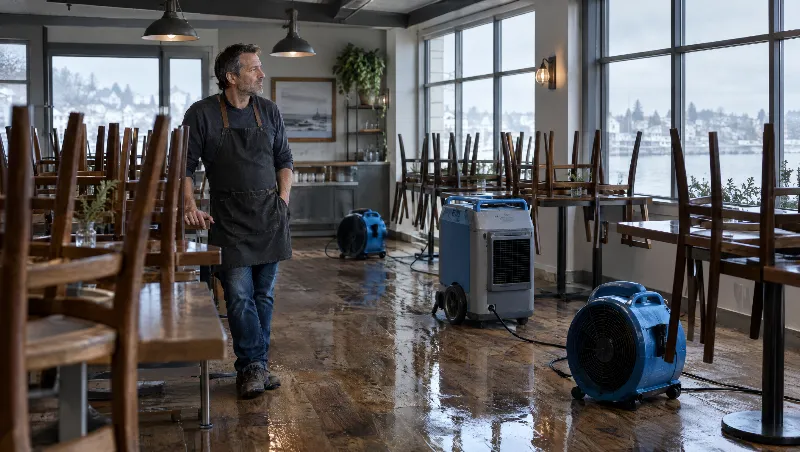
Business interruption insurance, sometimes called business income or loss of income coverage, pays you the money your business would have earned if a covered loss had not forced you to close or slow down. It also covers the bills that keep coming while you are shut, so you can reopen with your lease, your staff and your suppliers still in place. It is usually part of a commercial package for food businesses, attached to your property coverage.
The key idea: business interruption does not pay to fix the building or replace the equipment. Property and equipment breakdown cover do that. Business interruption pays for the time it takes. Insurers differ a lot on payroll, extensions and waiting periods, which is why our brokers compare terms from several hospitality-focused insurers instead of accepting the first wording offered.
What triggers it
In most policies, business interruption only responds when there is direct physical loss or damage from a peril your property policy covers. Typical triggers for a restaurant, café or hotel include:
- A kitchen fire, or smoke damage from a fire next door.
- A burst pipe during a February cold snap that floods the dining room.
- A storm that tears off part of the roof.
- A vehicle that drives into the front of the building.
- A covered equipment failure, if your equipment breakdown coverage includes an income extension.
No physical damage usually means no claim. A slow season, a bad review or a road closure for construction will not trigger the policy.
How lost income is calculated
This is where most owners have questions, so here it is step by step.
- Start with revenue you would have earned. The insurer looks at your sales history for the same period in past years and your recent trend. A patio restaurant that loses July is measured against past Julys, not against a February average.
- Subtract costs you no longer have. If you are closed, you are not buying food, paying for card processing on sales or running gas to the fryers. Those saved costs come off.
- Add back continuing expenses. Rent, loan payments, insurance, key salaries, software subscriptions and other fixed costs that keep running are covered.
- The result is your loss. In simple terms: the net profit you would have made, plus the fixed costs you still have to pay.
Payroll deserves a closer look. Some policies cover all payroll for the full period, while others cover ordinary payroll for a limited time. Keeping your trained kitchen and front-of-house team is often what makes a fast reopening possible, so we will show you how each option treats payroll.
Example: A family restaurant in Mississauga has a fire in the hood system on a Saturday night. Repairs to the kitchen take seven weeks. Based on the same weeks last year and this year’s trend, the restaurant would have earned a certain net profit and still owes rent, its loan payment and the salaries of its chef and manager. Business interruption pays that combined amount for the seven weeks, minus the waiting period, and the extra expense coverage pays for a rented refrigerated trailer to hold stock that survived. The owner’s broker helps assemble the sales records the adjuster asks for.
Waiting period
The waiting period, sometimes called a deductible period, is the stretch at the start of a closure that the policy does not pay for. It is commonly expressed in hours (for example, 24, 48 or 72 hours). A longer waiting period lowers the premium but leaves more of a short closure on you. Businesses that lose a lot of revenue in a single busy night, like a bar on a Saturday, may prefer a shorter one.
Indemnity period
The indemnity period is the maximum length of time the policy will pay. It usually starts on the date of the loss and runs until the business could reasonably be back up and running, capped at the period you chose. Twelve months is a common starting point, but it can be too short. Think about how long it would really take to get permits, rebuild a custom kitchen, source a replacement walk-in and rehire staff in your part of Ontario.
Some policies also offer an extended period of indemnity, which keeps paying for a while after you reopen, because customers do not all come back on day one.
Extra expense
Extra expense coverage pays reasonable costs you incur to avoid or shorten a closure. For food and hospitality businesses that can mean:
- Renting a commissary kitchen so catering orders keep going out.
- Moving to a temporary location or operating from a food truck.
- Overtime and rush shipping to get equipment installed faster.
- Rented refrigeration to save stock.
- Putting hotel guests up at another property to honour bookings.
These costs are often worth it because they reduce the overall income loss.
Civil authority
Civil authority coverage applies when a government authority stops access to your premises because of physical damage nearby, even though your own building is fine. A fire in the building next door or a gas leak down the street that leads police to close the block are typical examples. It usually has a short time limit, often a few weeks, and requires that the order be tied to damage from a covered peril.
Utility interruption
Many kitchen closures start with power, water or gas failing because of damage away from your property, such as a transformer fire or an ice storm bringing down lines. Standard business interruption may not respond because the damage is not on your premises. A utility interruption or service interruption extension fills that gap. Pair it with spoilage coverage so the food lost during the outage is also covered.
What business interruption usually does not cover
| Situation | Usually covered? |
|---|---|
| Closure after a kitchen fire | Yes |
| Closure after a burst pipe floods the dining room | Yes, if water damage is covered |
| Block closed by police after a fire next door | Often, under civil authority, for a limited time |
| Power cut from an off-site transformer fire | Only with utility interruption |
| Closure ordered for a disease outbreak | Usually excluded |
| Sales drop because of road construction | No |
| Closure from flood or earthquake | Only if those perils are added to the policy |
| Losing your liquor licence after a violation | No |
Other common exclusions include losses from wear and tear, closures caused by failure to follow health code, and income lost while you choose to renovate.
Which business do you run?
How much income protection you need, and which extensions matter most, depends on the type of operation. Find your business below for coverage advice written for it.
- Coverage for sit-down restaurants with table service, where a long kitchen rebuild means weeks of lost dinner sales.
- Insurance for quick-service and takeout counters, where volume and delivery revenue drive the loss.
- Coverage built for retail and wholesale bakeries, where daily sales and wholesale orders stop together.
- Insurance for coffee shops and cafés, where a single espresso machine can be the whole business.
- Coverage for mobile kitchens and food trucks, where a damaged truck means lost festival season.
- Insurance for caterers and event kitchens, where a closed kitchen means cancelled bookings.
- Coverage for bars, pubs and taverns, where a closed weekend can mean a big share of monthly sales.
- Insurance for craft breweries and taprooms, where production and taproom income both stop.
- Coverage for wineries and tasting rooms, where seasonal visitor revenue is hard to recover.
- Insurance for hotels, motels and inns, where lost room nights and cancelled events add up quickly.
- Coverage for bed and breakfasts and guest houses, where a handful of rooms is the whole income.
Getting a quote for business interruption
Fill in the short form on this page or call us at (416) 346-6886. One of our brokers reviews your sales and expenses with you and helps you choose a realistic indemnity period and waiting period. We take your application to insurers that suit your business, walk you through how each option treats payroll and extensions, and set up the policy you choose. We stay with you for certificates, changes, renewals and, if it ever happens, the claim.
Common questions
Is business interruption a separate policy?
For most food businesses it is part of the commercial package, attached to your property coverage. It responds when a covered property loss forces you to close or cut back, so it generally cannot be bought on its own.
Does business interruption cover a closure caused by a pandemic or health order?
Usually not. Most policies require direct physical loss or damage to trigger coverage, and many now carry specific exclusions for viruses and communicable disease. Our brokers will show you exactly what the wording says before you buy.
How do I prove what I would have earned?
The insurer looks at your financial records, usually your past sales, cost of goods and expenses, and adjusts for trends and seasonality. Clean monthly records from your accountant and point-of-sale system make the claim much faster, and we help you pull them together.
What is the difference between the waiting period and the indemnity period?
The waiting period is the time at the start of a closure that the policy does not pay for, often measured in hours. The indemnity period is the maximum length of time the policy will pay after a loss, often 12 months or longer.
Does it cover a power outage?
Only if your policy includes utility interruption, sometimes called off-premises power or service interruption. Many outages are caused by damage away from your property, so this extension matters for kitchens. See our page on equipment breakdown cover for power failures on your own premises.